The Money Is There. The Science Is Not.
Mar 16, 2026
Congress appropriated the money. It is not reaching investigators. That gap, between what is on paper and what is actually happening in labs and grant offices across the country is not an accident. It is the product of two decades of structural decisions universities made during good times, and an administration that has spent the past fourteen months exploiting every one of them.
The Trap Was Built Before Anyone Lit the Match
Research-intensive universities are in a worse position than most of them realize, and the reasons predate the current administration by two decades.
When Congress's fiscal year 2026 appropriations landed with a modest increase to NIH and a limited cut to NSF, there was genuine relief in many provost offices and university policy shops. That reaction tells you everything about how low expectations have fallen, and how poorly institutions understand the structural hole they are standing in.
The congratulations were premature. What universities are experiencing now is not a temporary political headwind. It is the collision of a decades-long accumulation of bad structural bets with an administration that has no interest in honoring the old terms of the relationship.
How the Good Times Built a Fragile System
The story starts in 2003. As I've written before, NIH's budget effectively doubled in the early 2000s, from roughly $12 billion annually in the 1990s to $28 billion by the early 2000s. Universities responded the way rational institutions respond to abundant resources: they grew into them. They built space. They hired. They constructed administrative cultures and faculty incentive structures around the assumption that this level of funding, or something close to it, was the new normal.
It wasn't. Budget growth since the austerity and sequestration measures that began around 2013 have not kept pace with inflation. The real purchasing power of federal research dollars has eroded, unnoticed for over a decade. But the institutional behaviors formed during the boom years proved stickier than the money did.
This is where the current strategic paralysis in institutions begins. Universities never had to learn how to make hard choices about research priorities during the era of abundance, and that habit of avoidance has followed them into a genuinely difficult moment. The full account of how this plays out strategically is worth reading. The TL;DR version: most institutions have neither the frameworks nor the institutional will to execute real strategy under pressure. Those muscles have atrophied due to lack of use.
The Structural Bets That Compounded the Problem
Abundant federal dollars also produced a set of structural incentives that felt rational in the moment and are now liabilities. The pursuit of indirect cost recovery encouraged institutions to maximize the size of their research portfolios regardless of whether that scale was sustainable. That logic, over time, transformed reimbursement into leverage, with indirect cost revenue becoming load-bearing infrastructure that institutions cannot easily walk back from or replace with diversification.
The downstream consequence is the soft money trap: faculty lines increasingly dependent on grant funding for salary support, creating a system where the imperative is perpetual funding acquisition rather than excellent science. When university leadership responds to financial pressure by demanding that units "do more with less," they are papering over a structural design flaw with a management slogan.
A Black Swan with a Paper Trail
Into this already fragile system came a second Trump administration, and with it, something that genuinely qualifies as a black swan event for research-intensive universities. No institution could have been expected to predict this precise confluence of outcomes, unless they had followed Project 2025 carefully, concluded that Trump would win a second term, and taken the document's proposals seriously as operational intent rather than political theater. Very few did.
The early months of 2025 brought shock and awe; dramatic grant cancellations that made headlines and generated lawsuits. But as I wrote in December, the more durable threat was always what would come next. The cancellations were loud. What followed has been quieter, more bureaucratic, and in many ways harder to fight.
Grant throughput is being significantly diminished even though Congress has protected agency appropriations despite the President's budget request. The mechanism is administrative, not legislative, and it is working.
The Administrative Shenanigans Portion of the Program
A lot has happened in the past 14 months, and universities have understandably been pulled in every direction - defending against indirect cost rate caps, untangling DEI compliance requirements, navigating foreign subaward restrictions, managing research security obligations, processing an avalanche of no-cost extension requests under ever-evolving processes, managing litigation exposure from abrupt cancellations, and responding to shifts in public access policy. All of that is real and consequential. But it is not actually the game.
The ball game is grant throughput. Specifically, the ways this administration has constructed a set of overlapping mechanisms that reduce the number of grants flowing to investigators, without ever requiring Congress to cut a single appropriation. That is the central story, and it seems like institutions aren’t talking about it.
Here is what has actually happened.
The people who process grants are disappearing. NIH has lost approximately 20% of its workforce through DOGE-driven layoffs, buyouts, and attrition - falling from roughly 21,100 employees to around 17,000. Program officers who understand portfolios, relationship nuance, and the science are gone or under pressure. Vacancies at the director level remain unfilled. Now, key grantmaking positions face reclassification under the new Schedule Policy/Career category, which strips civil service job protections and will make it far easier to remove employees who don't comply with administration priorities. The institutional capacity to process and award grants at normal volume has been materially reduced, even when the money technically exists.
The pipeline of new opportunities has been deliberately narrowed. Rather than issuing funding opportunity announcements, NIH has shifted toward publishing "highlighted topics" - a new mechanism that former NIH staff have documented in detail as a significant departure from how scientific priorities have historically been communicated and operationalized. Fewer and differently shaped opportunities means a thinner pipeline of proposals, which means fewer grants, regardless of what the appropriation says.
Peer review has been compromised at the front end and bypassed at the back end. NIH has abandoned the use of paylines - the score-based thresholds that historically translated peer review results into funding decisions in a predictable, transparent way. Paylines are gone. In their place, political appointees now have formal authority to make final funding decisions, enshrined by executive order. Peer review still happens, but its results are advisory at best and ignorable at worst. NIH staff have described in reporting being directed to ensure grant reviews reflect alignment with administration priorities. Meanwhile, grant review panels for more than half of NIH's institutes are on track to lose all their voting members by the end of 2026 - and federal law requires these panels to review applications before funding can be awarded, meaning the ability of those institutes to issue new grants could soon be frozen entirely.
The multi-year funding mandate is devastating. NIH has implemented a requirement that 50% of competing research project grant dollars be committed upfront as multi-year awards. The math is brutal. Front-loading funding this way effectively quadruples the immediate cost of each new award, which means NIH can fund dramatically fewer studies in a given cycle - even with a flat budget. At the National Cancer Institute, the expected payline for new investigators has already fallen to the 4th percentile - down from the 10th percentile the year prior. An entire class of highly competitive applications that would have been funded under any prior administration will simply not be funded. And because this reduces outyear financial commitments on paper, it potentially creates the conditions for the administration to later argue that the NIH budget was always inflated and can be cut without consequence.
Congress did express concern. The fiscal year 2026 appropriations agreement includes language noting strong worry about the policy's impact on success rates and the number of fundable grants, and directs NIH to fund as many new awards as possible based on merit. A general provision was included to limit how much can be obligated for fully front-loaded awards. But the language stops well short of prohibition - and here is the practical reality: NIH is so far behind on getting money out the door that multi-year funding may be one of the few mechanisms available to spend down the appropriation before the fiscal year ends. Congress may have tepidly chided the policy while simultaneously leaving NIH with little choice but to use it. The chiding is noted. The structural damage is continuing.
Approved money is being held. Even when Congress has acted and appropriations have been passed, spending has not flowed freely. The White House has stalled release of agency spending plans for NIH, NSF, and NASA. Appropriated dollars sitting unspent do not fund science.
None of these mechanisms require a single vote in Congress. Each one, in isolation, might be characterized as a procedural adjustment or a management decision. Taken together, they constitute a systematic reduction in the actual flow of research funding to investigators - achieved entirely within the administrative apparatus, largely out of public view, and extremely difficult to litigate.
What the Numbers Actually Say
The effects are already visible in the data. The overall number of investigators winning R01-equivalent grants dropped from 7,720 in 2024 to 5,885 in fiscal year 2025 - nearly 1,900 fewer funded scientists in a single year. For early-stage investigators, the funding rate fell from 26% to 19%. For established investigators, from 27% to 20%. For at-risk investigators - those who will lose all NIH support if they don't secure a competing award - the rate fell to 17%, down from 24%.
That is before fiscal year 2026. We are now halfway into the new fiscal year. According to tracking by former NIH staff, only 14 new funding opportunity announcements have been released so far - in a year that would typically produce hundreds. The multi-year funding mandate, already responsible for thousands of fewer grants issued in 2025 is continuing apace. Modeling suggests it would take approximately six years to return to 2024 award levels - by which point the research workforce will have contracted so significantly it could not support that volume of science.
Annual Publication of Notices of Funding Opportunities
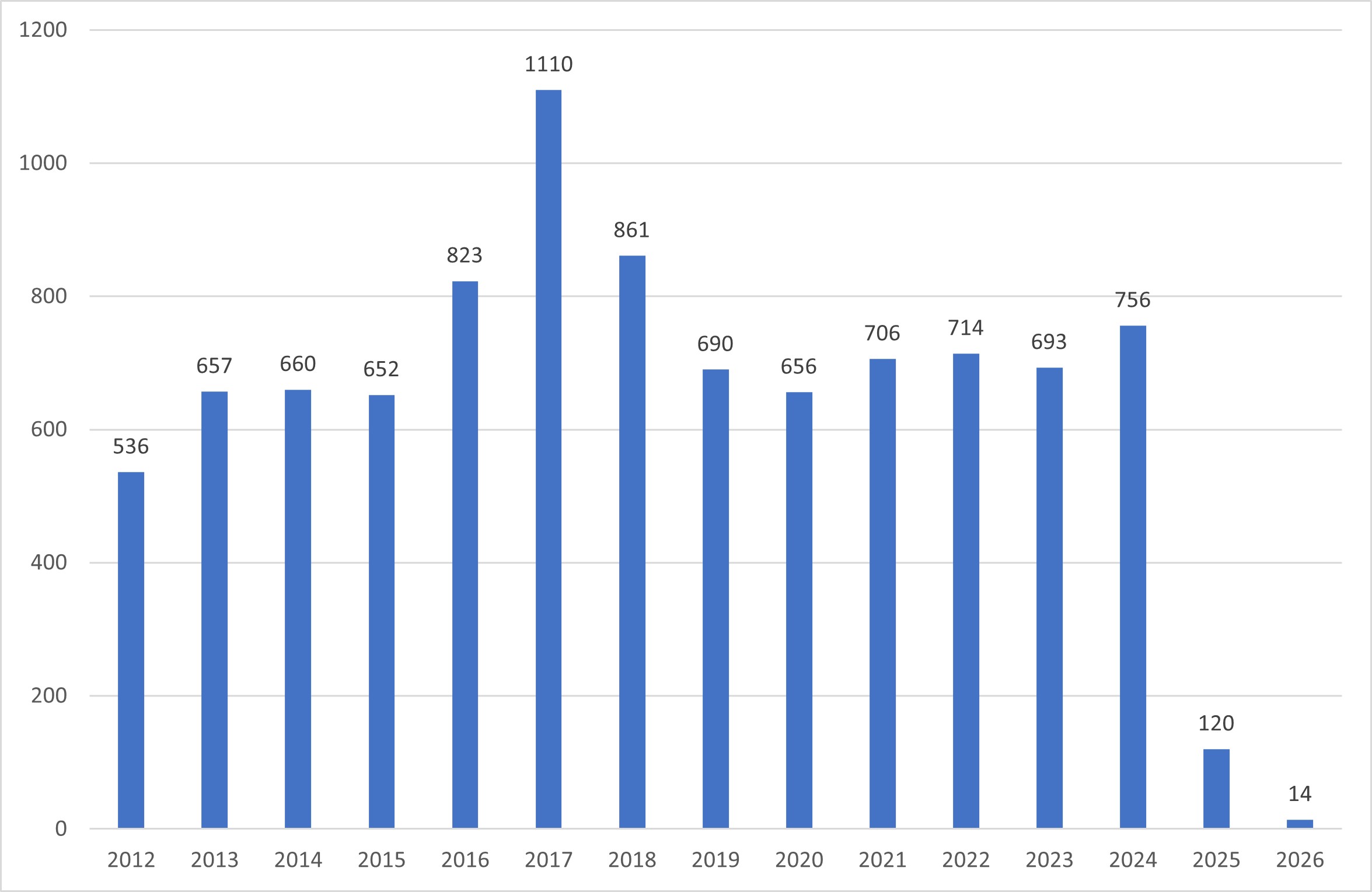
Source: Elizabeth Ginexi, I Wrote Research Funding Announcements for NIH for 22 Years. This Year They’ve Published 14
Fiscal Year 2026 Funding Curve (through January 1st, 2026)

Source: Dr. Jeremy Berg's Github page
Understanding and Modeling NIH Research Grant Success Rates and the Impact of “Multiyear Funding”
