F&A Reimbursement, Risk, and the Illusion of Growth
Jan 21, 2026
Since NIH released NOT-OD-25-068 in February of last year, I’ve been obsessed with indirect cost recovery. I’m not an economist, and I don’t have visibility into university balance sheets - they’re not transparently shared. But it’s hard not to notice that universities often talk about indirect cost recovery in a way that feels like “girl math”: money that is framed as reimbursement, not revenue, yet treated as available for growth.
Full disclosure: I don’t actually know how money moves once it hits the central ledger. What I can see is how institutions behave. They expand research space, hire faculty with soft-money expectations, and build permanent obligations around funding streams that are competitive, uncertain, and externally controlled. That gap, between how indirects are described and how they are operationally used is what I’ve been trying to understand.
For anyone who actually does know what the typical and inflows and outflows look like at the institutional level, feel free to take me task if I've drawn the wrong conclusions.
I want to start with a deliberately mundane thought experiment inspired by 2017 Congressional testimony by Kelvin Droegemeier, because the dynamics it exposes are easier to see in household finance than they are inside the abstractions of university budgeting.
Imagine you are a homeowner whose roof needs to be replaced. Your insurance policy requires you to pay the contractor up front and then reimburses you after the work is completed. You draw on savings or a line of credit, replace the roof, submit the claim, and eventually receive the reimbursement. So far, this is unremarkable. The key decision comes next. Instead of using the reimbursement to restore your savings or pay down the debt you incurred, you roll that cash flow into a kitchen remodel. The house is now nicer and more impressive, but(!) it also comes with higher fixed costs and a greater dependence on continued access to liquidity.
Now imagine that this pattern repeats. Each time a reimbursable repair is completed, the reimbursement is treated less as cost recovery and more as discretionary income. Over time, you begin to structure your household finances around the expectation that these reimbursements will continue. You take on larger obligations. You expand the footprint of the house. You assume that future claims will materialize, be approved, and arrive on a reasonable timeline. What started as a timing issue; fronting costs and being reimbursed, becomes a leverage strategy.
In higher education, institutions routinely front the costs of sponsored research. They pay salaries, build and maintain space, staff compliance offices, invest in administrative infrastructure, and carry costs that are only partially and retrospectively reimbursed through grants and facilities and administrative (F&A) recovery. In principle, reimbursement is meant to offset expenses incurred on behalf of the sponsor. In practice, however, reimbursement flows are often absorbed into the institution’s general financial ecosystem. Rather than being reserved to stabilize research operations, they are leveraged to support capital projects, administrative growth, or institutionally favored initiatives.
The analogy becomes sharper when we consider hiring practices. Universities frequently hire faculty with the implicit or explicit expectation that a significant portion of their salary will be covered by grant funding. This is a known practice that was openly discussed recently in an interview with Mike Lauer on the Statecraft podcast. This allows the institution to expand its research footprint while limiting its direct salary exposure - at least on paper. But unlike a homeowner who can choose whether to remodel, these hires create permanent fixed obligations. Faculty lines do not scale down easily when funding ebbs. Space, compliance responsibilities, and administrative expectations persist regardless of grant success.
In effect, the institution behaves as though uncertain, competitive, externally controlled revenue can be treated as quasi-operating income. This is the critical move and probably why annual grant expenditure features prominently on end-of-year reports. It converts reimbursement into assumed revenue and transforms growth into a structural dependency. The upside, which includes prestige, rankings, indirect cost recovery, expanded influence, accrues centrally and immediately. The downside materializes later and diffusely: faculty experience chronic precarity and burnout, departments absorb volatility, potential deferred maintenance accumulates, and everyone is expected to do more with less.
This is where moral hazard enters the picture, not as an accusation of bad intent, but as a systemic condition. Decision-makers are not immune to downside risk, but they experience it later, more diffusely, and less personally than those downstream. Leadership teams are rewarded for growth, expansion, and ambition, while the consequences of overextension reveal themselves when the prior terms and conditions are removed, as in, policies that change the Indirect Cost Recovery status quo. Reimbursements are fungible, and there is little structural pressure to reserve them against future research obligations. Success is measured by volume: total research dollars, number of awards, size of the portfolio, rather than by sustainability.
Mission creep, then, is not an aberration. It is a rational response to the incentive environment in which universities operate. Rankings reward scale. Federal funding mechanisms reward demonstrated capacity. Prestige compounds. Retrenchment is reputationally costly, while expansion is recognizable and recognizable success is rewarded. Growth masks fragility, and short-term solvency can easily be mistaken for long-term viability.
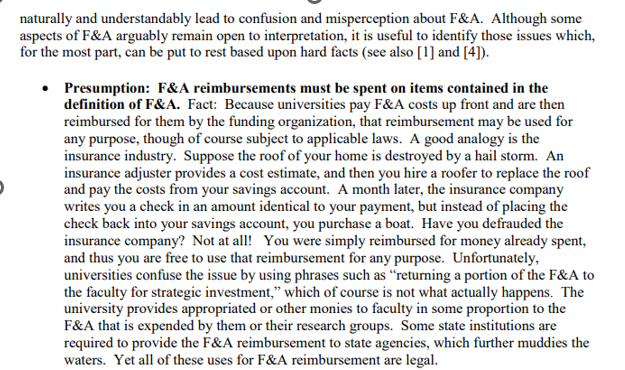
Droegemeier testimony to the House LHHS appropriations subcommittee, 2017
Returning to the homeowner analogy helps clarify the stakes. The homeowner is not reckless in isolation. Each individual decision makes sense given the information and incentives at hand. The problem emerges when the household begins to assume that insurance reimbursements will continue indefinitely and structure its fixed costs accordingly. When claims are delayed, denied, or fundamentally altered, the household discovers that what looked like prosperity was, in fact, leveraged debt.
There’s no doubt reimbursable research funding for indirect expenditures is valuable – it’s critical. The question is whether institutions are honest about the risk they are accumulating by treating reimbursement as growth capital rather than cost recovery that goes back into supporting the research enterprise more directly. When uncertain revenue underwrites permanent expansion, the system becomes breakable. Faculty absorb pressure. Departments operate in a constant state of triage. Offices and departments are blamed for failures that originate upstream in structural assumptions.
If there is a lesson here, it is not that universities should stop pursuing research growth. It is that growth without explicit risk accounting produces exactly the conditions many institutions now find themselves in: potentially overleveraged, overstretched, and struggling to reconcile their mission with their balance sheets. The house may look impressive from the outside. But it is far more expensive, and far more fragile, to maintain than their financials suggest.
University leadership often responds to these concerns by asserting that research is, in fact, a “loss leader” for the institution. In a narrow accounting sense, this can be true, particularly at biomedical campuses with heavy regulatory, facilities, and compliance burdens. Even with negotiated F&A recovery, universities frequently subsidize research through debt service on specialized buildings, underrecovered indirect costs, startup packages, bridge funding, and the support of core facilities that never fully break even by statutory mandate. But this framing obscures as much as it reveals.
Research may be cash-negative within a discrete ledger while remaining strategically accretive at the institutional level, enabling tuition revenue, clinical volume, philanthropy, state appropriations, bond-market confidence, and reputational capital that leadership does not attribute back to research when calculating “loss.” The more telling contradiction is behavioral: institutions that truly believed research was merely a financial drain would constrain growth, align hiring tightly to guaranteed revenue, and limit capital expansion. Instead, universities expand research aggressively, hire faculty with soft-money expectations, and treat reimbursed activity as a foundation for permanent obligations.
The loss-leader narrative, then, functions less as a diagnosis than as a political and managerial shield, justifying central retention of indirect costs while deflecting scrutiny of how risk is accumulated, distributed, and ultimately absorbed.
This structural confusion is often exacerbated by external critiques that misidentify the problem entirely. A prominent example is a Heritage Foundation report from 2022 that argues indirect cost reimbursement represents a taxpayer “subsidy” that enables universities to fund ideological or non‑research priorities. In this framing, F&A recovery is portrayed as excess revenue, untethered from real costs, and therefore ripe for abuse. The proposed remedies include capping indirect rates at levels accepted from private foundations or sharply reducing federal research funding, which are presented as mechanisms to discipline institutional behavior.
This critique is analytically weak because it attacks the fungibility of reimbursement without grappling with why fungibility exists in the first place. Indirect cost recovery is not a profit margin layered onto research; it is reimbursement for real, audited, and negotiated costs that institutions incur up front in order to conduct federally sponsored research at all. Utilities, depreciation, compliance staff, IT security, animal care, human subjects’ protection, export controls. These costs do not disappear simply because a sponsor wishes to pay less. When private foundations cap indirect rates, universities do not become more efficient; they cross‑subsidize those projects using other institutional funds, including federal reimbursements. Treating private rates as a market signal rather than a philanthropic discount fundamentally misunderstands the economics of research infrastructure.
More importantly, the Heritage argument misses the central issue entirely. The problem is not that reimbursed funds can legally be spent on a wide range of purposes. As Kelvin Droegemeier’s 2017 Congressional testimony correctly notes, reimbursement by definition occurs after costs are incurred, and institutions are free to allocate recovered funds consistent with law and policy. The problem is that reimbursement flows - federal, state, and private - are routinely treated as a stable foundation for permanent expansion. Critiques that focus on ideological misuse or waste obscure the more consequential dynamic: universities increasingly organize themselves around uncertain, competitive revenue streams while locking in fixed obligations that cannot be unwound when funding conditions change.
In this sense, Heritage’s proposed solutions would likely worsen the very fragility they claim to oppose. Artificially constraining indirect recovery without addressing hiring incentives, capital planning, or risk allocation would further decouple costs from revenue, deepen cross‑subsidization, and push more financial risk onto individual investigators and departments. It would not shrink administrative complexity; it would simply make it harder to pay for the infrastructure that complexity already requires.
What both the defensive legal framing and the ideological critique fail to confront is the same underlying reality: the reimbursement model, combined with prestige‑driven growth incentives and soft‑money labor expectations, encourages institutions to behave as though variable external funding were dependable operating revenue. This is not a story about fraud, waste, or political capture. It is a story about rational actors responding to misaligned incentives in a system that rewards expansion and defers accountability for risk.
The reality almost certainly lies somewhere in the middle. Universities are not monolithic, and their financial practices vary widely by size, mission, governance, and risk tolerance. Some institutions are disciplined, conservative, and explicit about the tradeoffs they are making. Others appear far more aggressive, building long-term commitments atop funding streams that are uncertain by design.
This makes broad claims; either that indirect costs are being “abused” or that the system is working exactly as intended, which is unsatisfying. The same reimbursement structure can enable prudent stewardship in one institution and overextension in another. What looks like responsible portfolio management in one context can resemble leverage-driven growth in another, even though both are operating within the same rules.
The harder question, then, is not whether indirect cost recovery is legal or even necessary - it clearly is - but how variation in institutional behavior shapes risk, resilience, and outcomes when external conditions change.
**********
Additional Resources
How to save science funding, Statecraft podcast 12/4/25
