In Strategy, Sequence Is Everything
Mar 15, 2026
Why strategy must come before planning and why getting the order wrong is the most common mistake in higher education.
This piece synthesizes and extends the series on strategy, planning, and organizational design in research-intensive higher education. It is designed to stand alone as a framework, and to serve as a capstone for readers who have followed the earlier pieces. If you are new to the series, this is a good place to start, then read backward through the prior installments for the deeper context.
The earlier pieces in this series have argued that strategy and planning are different things, that strategic thinking requires honest outside perspective, that strategy disappears inside institutional structures, and that the practice of placing deliberate bets and running experiments is how organizations build strategic capacity over time. Those arguments stand. What this piece does is name the thread that runs through all of them.
The thread is sequence. Not the difference between strategy and planning as concepts, but the order in which they have to happen for either one to work. An old military adage, "the 6P Principle" captures it precisely: proper planning prevents piss poor performance. The catch? The part that higher education consistently misses, is that proper planning requires a coherent strategy first. Get the sequence wrong and you get what most institutions produce: a planning process that substitutes for strategic thinking, a document that substitutes for a plan, and execution that stalls because neither the direction nor the preparation was real.
Higher education does this constantly. And it calls the result strategic planning.
The Sequencing Problem
Here is what actually needs to happen, in order, when an institution or school is facing a significant challenge or change:
First, think slowly and honestly about the destination. Second, plan with precision and discipline once the destination is clear. Third, execute with speed once the plan is solid. Fourth, protect the work from the institution's own gravitational pull toward the familiar.
Most higher education institutions collapse the first two steps into a single process, skip the honest parts of both, and then wonder why execution stalls. The five-year strategic plan is the artifact of this collapse. It looks like thinking and planning happened. What actually happened is a negotiation that produced a document.
A strategic plan is not proof that strategy occurred. It is often proof that consensus occurred instead.
The distinction matters because consensus and strategy require different things. Consensus requires that everyone feel heard and that no priority be visibly subordinated to another. Strategy requires exactly the opposite: visible choices, acknowledged trade-offs, and a clear answer to what you are not doing and why. You cannot produce both in the same process. When you try, strategy loses.
Think Slow: The Step Higher Education Skips
Bent Flyvbjerg spent decades studying why large, ambitious projects fail across hundreds of cases worldwide. His findings are striking and remarkably consistent.
His most important contribution is not a framework for execution. It is a discipline for the moment before commitment. He calls it the outside view: the practice of asking, before you commit to anything, what actually happened when comparable organizations tried comparable things. Not what you hope will happen. What happened.
Most higher education leaders never do this. They do an inside view instead. They assess their own situation, their own strengths, their own context, and conclude that their project is different enough from past failures to warrant optimism. It usually is not. The research on this is unambiguous: inside views systematically underestimate cost, timeline, and complexity, and overestimate the organization's capacity to execute.
What makes this especially acute in higher education is that the planning process itself generates optimism bias in a way that private sector planning rarely does. In a shared governance environment, the people in the room during a strategic planning process all have a stake in the initiative being approved. Faculty want their priorities reflected and portfolios protected. Deans want their units represented. The process is designed to produce consensus, which means it is structurally biased toward saying yes to everything and toward understating the trade-offs that real commitment requires. By the time a plan is approved, the room has collectively talked itself into believing the assumptions, not because anyone was dishonest, but because the incentive structure rewards optimism and penalizes skepticism. The outside view never had a seat at the table.
The slow thinking step is not a planning retreat. It is not a SWOT analysis. It is a genuine interrogation of assumptions before they harden into commitments. What are we actually trying to achieve, in terms specific enough to be tested? What would tell us, twelve months from now, that this is working? What happened when other institutions tried this? What did it actually cost them, in time, money, and political capital? And critically: do we have the operational capacity to execute this, or are we counting on capacity that does not exist?
If those questions cannot be answered with reasonable specificity, the institution is not ready to plan. It is still in the strategy phase, whether it knows it or not.
Plan Hard: The Science of Execution
Once the strategic question is genuinely settled, planning becomes a different kind of work. Not a political exercise. A technical one. This is where the 6 P principle earns its name.
Good execution planning in Flyvbjerg's framework has three features that are almost entirely absent from higher education strategic plans. First, it is modular: the work is broken into components that can be tested, evaluated, and adjusted independently, so that one piece failing does not collapse the whole. Second, it is hypothesis-driven: each initiative has explicit assumptions, measurable outcomes, and defined decision points where the organization asks whether the assumptions are holding. Third, it has named owners, not committees. A committee is responsible for process. A person is accountable for outcomes. Those are not the same thing, and conflating them is one of the most reliable ways to ensure nothing gets done.
This kind of planning is harder than producing a strategic document. It requires committing to specifics that can be evaluated. It requires allocating real resources to stated priorities rather than aspirational budget lines. It requires acknowledging, in writing, what you will stop doing in order to do this. Most institutions find each of these requirements uncomfortable enough to avoid them. The result is plans that are detailed enough to look serious and vague enough to be unfalsifiable.
An initiative with no named owner, no budget line, and no measurable outcome is not a plan. It is a wish with a deadline attached.
Protect the Work
The step that almost no framework names explicitly is the last one: once you have a real strategy and a real plan, you have to protect both from the institution's immune system.
Higher education institutions are remarkably good at absorbing change initiatives and neutralizing them without anyone making a deliberate decision to do so. Competing priorities accumulate. Scope creep sets in. The people with the most institutional memory and the most political capital surreptitiously redirect energy toward what they know. New urgencies arrive and displace existing commitments. And gradually, the initiative that was supposed to be different becomes indistinguishable from the ones that came before it.
Flyvbjerg's answer to this is structural: a leader with genuine authority and genuine accountability for outcomes, not just for process. In higher education terms, this means someone who can say no to the scope creep, hold the resource allocation, and be evaluated on whether the bets delivered results rather than whether the planning process was inclusive. That is a harder role to fill than it sounds, and it requires institutional conditions that many schools do not currently have. But naming it is the first step toward creating it.
A Framework for Gnarly Problems
Pulling this together into something usable: here is the sequence that actually works, drawn from Flyvbjerg's research and from the patterns visible across higher education institutions right now.
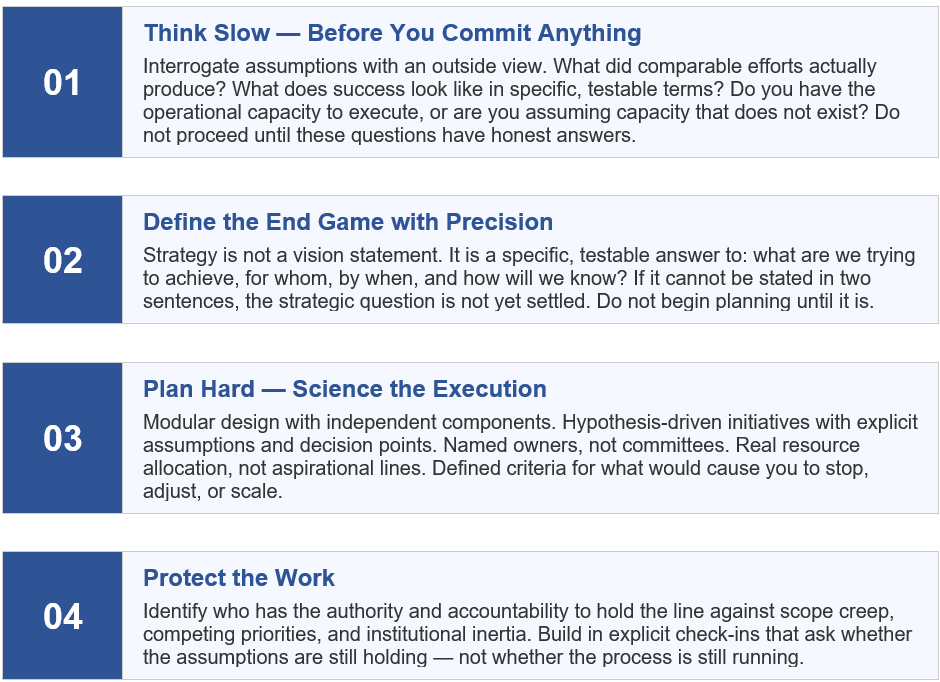
The reason big things rarely get done well in higher education is not a shortage of ambition or intelligence. It is a sequencing problem. The right things happen in the wrong order, or simultaneously, or not at all. Fixing that does not require a new strategic planning process.
The sequence is not complicated. Think before you plan. Plan before you act. Protect the work once it is moving. What makes it hard is not the framework, it is the willingness to hold the line against a system that was designed to produce something else. That willingness is a leadership decision. It is also, right now, one of the most consequential ones a research leader can make.
Further Reading
How Big Things Get Done | Bent Flyvbjerg and Dan Gardner, 2023
The most data-grounded account of why large projects fail and what the ones that succeed actually have in common. Flyvbjerg's outside view framework and his argument for modular, iterative execution are the backbone of the sequencing argument in this piece. Essential reading for anyone leading a significant organizational change.
Thinking, Fast and Slow | Daniel Kahneman, 2011
The foundational text on why human judgment is systematically unreliable under uncertainty, and the conditions under which slow deliberate thinking produces better decisions than fast intuitive ones. Kahneman developed much of this work in collaboration with Amos Tversky, whose influence runs throughout. The chapters on optimism bias and the planning fallacy speak directly to the failure modes described in this series.
The Black Swan | Nassim Nicholas Taleb, 2007
Taleb's argument that rare, high-impact events are systematically underestimated by institutions and experts alike has direct implications for how research-intensive universities should think about risk, resilience, and the limits of long-range planning. The current federal funding environment is, in many respects, a black swan that most strategic plans were not built to absorb. Taleb's framework is a useful corrective to the overconfidence that planning processes tend to produce.
